Two Models, One Goal
Startup incubators and accelerators both exist to help founders build companies. They share surface-level features: mentorship, cohort structures, demo days, and connections to capital, but the two models are designed for different founders at different stages, and choosing the wrong one wastes time on both sides.
If you're a founder deciding where to apply, the model determines what kind of support you'll get and what you'll give up in return. If you're an ESO operator designing a program, the model shapes everything from your funding structure to your curriculum to the outcomes you report.
How Startup Incubators Work
A startup incubator supports founders in the earliest stages. The typical participant has a concept, maybe a prototype, but hasn't proven that the market exists or that the product can generate revenue.
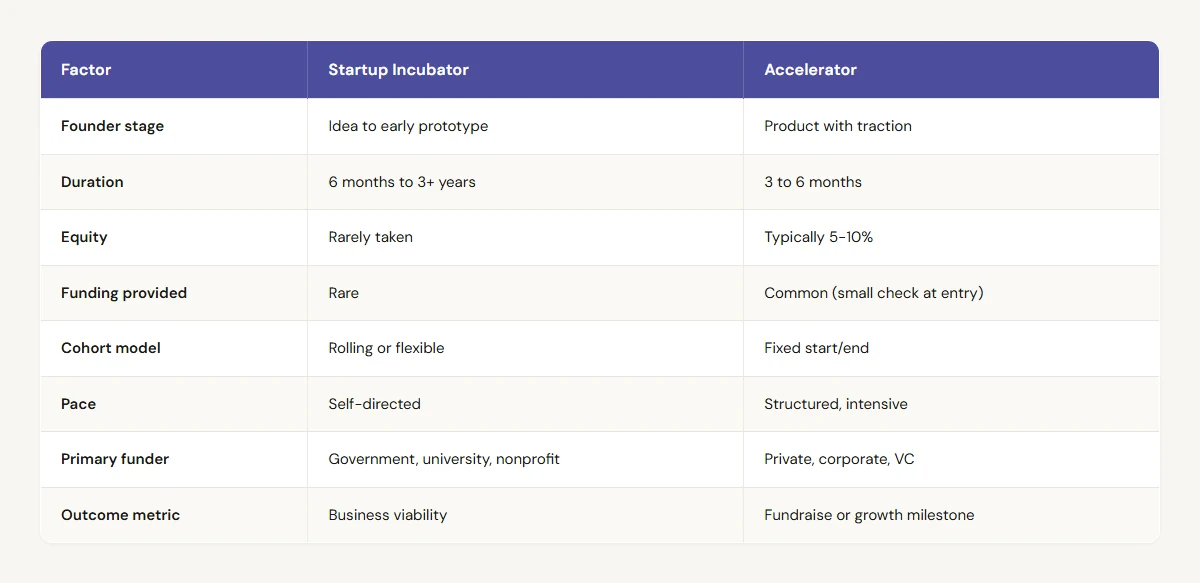
Incubators operate on longer timelines, typically six months to several years. Some use rolling admissions instead of fixed cohort start dates. The programming is flexible and broad, covering fundamentals like market validation, business model development, and early customer acquisition. Most are funded by universities, government grants, or nonprofit sponsors, and they rarely take equity. The value exchange is access to resources, not a financial stake in the company.
The goal is viability: help the founder reach a point where the business can sustain itself or attract its next stage of support.
For a deeper look at what incubators are and how they operate, see the full guide on what a business incubator is.
How Accelerators Work
An accelerator targets founders who already have a product, some traction, and a team. The work is compressing the time between where the startup is now and a specific milestone, usually a funding round.
Accelerators run on fixed timelines, typically three to six months. According to Silicon Valley Bank, accelerator programs generally run for a set period, typically around three months, and culminate in a demo day where startups pitch to investors.4 Cohorts start and end together. The programming is intensive: daily workshops, weekly mentor sessions, and a final demo day where founders pitch to investors.
Most accelerators take equity, usually 5% to 10%, and provide a small investment at admission.1 According to Y Combinator, its standard deal invests $500,000 in every company for a fixed 7% stake (via a $125K safe) plus an uncapped MFN safe for the remaining $375K.2 According to Techstars, its program invests $220,000 and takes 5% of the company in common stock plus an uncapped MFN safe.3 The economics are venture-aligned. The accelerator's success depends on the financial performance of its portfolio.
The goal is velocity: move the founder toward investment-readiness as fast as possible.
Key Differences at a Glance
Which One Is Right for You?
If You're a Founder
Ask yourself two questions. First: do you have a product that people are paying for, or are you still figuring out what to build? If it's the latter, an incubator gives you the time and breadth of support to get there. If you have traction and need to raise capital, an accelerator puts you in front of investors faster.
Second: are you willing to give up equity? If not, incubators are the better fit. If you're, make sure the accelerator's network, brand, and programming are worth the trade. Giving away 7% of your company for a mediocre three-month program is a bad deal at any stage.
If You're Building a Program
Start with your founders. If your applicant pool is mostly first-time entrepreneurs without a product in market, you're building an incubator. If you're attracting founders with revenue and product-market fit, you're building an accelerator. The founder population decides. Not your preference.
Your funding model matters too. Grant-funded programs with community impact mandates align with incubator structures. Programs with private capital or corporate sponsors are better positioned to run an equity-based accelerator model.
Many programs serve both populations and run hybrid models with different tracks for different stages. A lifecycle framework makes this possible by diagnosing each founder's stage at intake and routing them to the right track.
Where Venture Capital Fits In
Venture capital is sometimes grouped into this comparison, but it serves a different function entirely. VCs invest capital in exchange for equity. They don't provide structured programming, mentorship systems, or cohort management.
Some VC firms operate affiliated accelerators (Y Combinator, Techstars). In those cases, the accelerator provides the structure and the VC arm provides the capital. They're complementary, not interchangeable.
For a more detailed breakdown including VC, see the full comparison guide on business incubator vs accelerator models.
Frequently Asked Questions
What's the main difference between a startup incubator and an accelerator?
Incubators support earlier-stage founders over longer timelines with flexible, broad programming and no equity requirement. Accelerators run shorter, intensive programs for founders with existing traction, usually in exchange for equity.
Can a program be both an incubator and an accelerator?
Yes. Many programs blend elements of both, especially those serving founders at multiple stages. The key is matching the structure to the founder's current stage rather than applying one model to everyone.
Do incubators or accelerators produce better startups?
Neither model is inherently better. Outcomes depend on whether the program structure matches the founder's stage. An incubator is the right fit for idea-stage founders. An accelerator is the right fit for growth-stage founders.
How do I find a startup incubator or accelerator near me?
Search by location and focus area. Many programs are listed through regional economic development agencies, university entrepreneurship centers, and directories maintained by organizations like the International Business Innovation Association (InBIA), a nonprofit membership association serving entrepreneur support organizations in more than 30 countries.5 Also see how to run a startup accelerator for operational context.
What's the best way to manage an incubator or accelerator?
Programs that scale successfully invest in operational infrastructure early. A unified ESO management platform handles applications, cohort tracking, mentorship coordination, and sponsor reporting in a single system.
Explore how Startup Science helps ESOs track founder progress and prove program ROI.
Sources
- Carta, Startup Accelerators: How Accelerators Help Grow Your Startup, 2024. carta.com
- Y Combinator, The Y Combinator Standard Deal, 2024. ycombinator.com
- Techstars, Techstars Investment Terms Update, 2025. techstars.com
- Silicon Valley Bank, How do startup accelerators work?, 2023. svb.com
- International Business Innovation Association, About InBIA, 2024. inbia.org