Why the Distinction Matters
The terms "incubator" and "accelerator" get used interchangeably across the startup ecosystem. Program websites blur the lines. Founders apply to both without understanding what they're signing up for, and ESO operators building new programs often pick a label before they've defined the model they actually need.
The distinction matters because the two models serve different founder stages, operate on different timelines, and produce different outcomes. Choosing the wrong structure wastes resources for the program and time for the founders it serves. A business incubator and an accelerator aren't interchangeable, even though they share surface-level similarities like mentorship, cohort models, and demo days.
Understanding the difference starts with understanding where your founders are in the startup lifecycle.
What a Business Incubator Does
A business incubator supports founders in the earliest stages of company building. The typical incubator participant has an idea or early prototype but hasn't yet validated the market, built a team, or generated revenue.
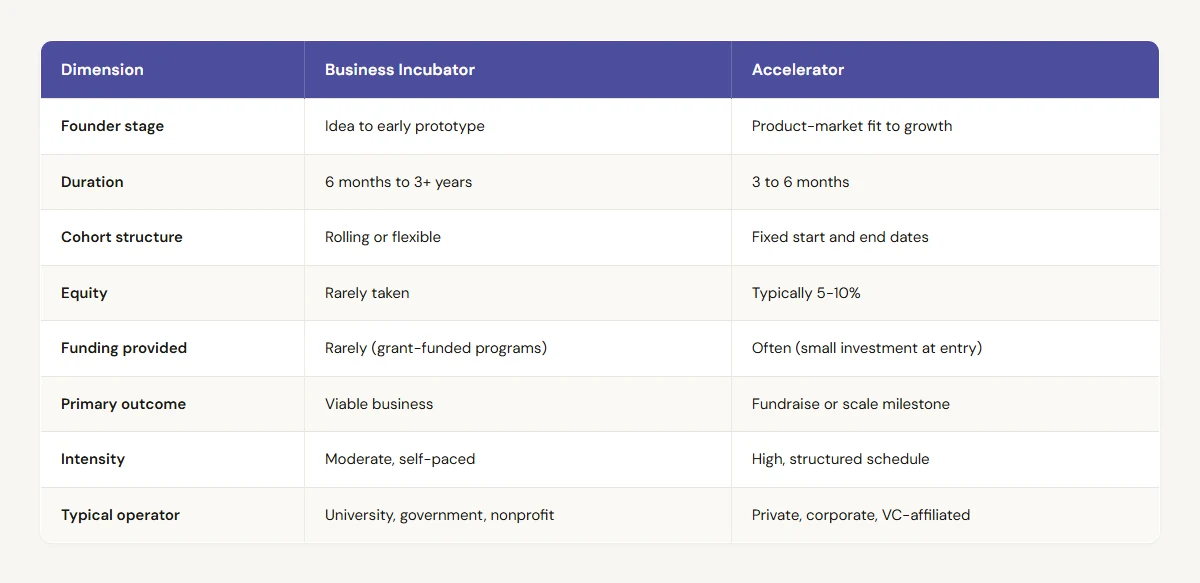
Incubators run longer, six months to several years. According to Harvard Business School Online, incubators typically last between one and five years and often operate on rolling admissions rather than fixed cohorts.1 The programming is broad and flexible, covering everything from business model development to legal basics to early customer discovery.
Most incubators don't take equity. According to the International Business Innovation Association (InBIA), many incubators are run by nonprofit development corporations, academic institutions, and government-supported bodies that don't make equity-based financial commitments.2 Nonprofit, university, and government-funded programs are typically free to participants. Private incubators sometimes take equity, but the norm across the broader incubator world skews toward grant-funded or sponsor-funded models.
The goal of an incubator is survival. Help the founder get from idea to viable business. Reduce the early-stage mortality rate by providing structure, guidance, and resources that most first-time founders lack access to on their own.
What an Accelerator Does
An accelerator works with founders who already have a product, some traction, and a team. The typical accelerator participant is past the validation stage and looking to scale quickly toward a funding round or a major growth milestone.
Accelerators run on fixed timelines, usually three to six months. According to Silicon Valley Bank, accelerators are fixed-term, cohort-based programs that typically last three to six months and provide intensive, structured support in exchange for seed investments.3 Cohorts start and end together. The programming is intensive and compressed, with heavy emphasis on pitch preparation, investor introductions, and go-to-market execution.
Most accelerators take equity, typically between 5% and 10%.3 For example, Y Combinator invests $500,000 for 7% equity plus an uncapped MFN SAFE,4 and Techstars invests $220,000 for 5% common stock plus an uncapped MFN SAFE in its three-month mentorship-driven accelerator.5 The exchange is access to capital (many accelerators provide a small investment at admission), a concentrated mentor network, and the signal value of being accepted into a competitive program.
The goal of an accelerator is velocity. Compress the time between where a founder is now and where they need to be to raise their next round or hit a growth target.
Side-by-Side Comparison
Where the Lines Blur
In practice, many programs combine elements of both models. A university might run a six-month program with a fixed cohort (accelerator structure) but accept pre-revenue founders and take no equity (incubator economics). A private firm might call itself an incubator but run three-month sprints and take 7% equity.
The label matters less than the design. What matters is whether the program's structure matches the needs of the founders it serves. Get this wrong and nothing else saves you. A program that accepts idea-stage founders but runs an accelerator-pace curriculum will burn through participants who aren't ready for that speed. A program that accepts growth-stage companies but offers only foundational workshops will bore them.
This is where a defined framework helps. Programs built on a lifecycle model can diagnose where each founder sits and adjust the resources accordingly, regardless of whether the program calls itself an incubator or an accelerator.
Incubator vs. Accelerator vs. VC
Venture capital is sometimes grouped into this conversation, but it serves a different function. VCs provide capital in exchange for equity. They don't typically provide structured programming, mentorship infrastructure, or operational support.
Some VC firms run affiliated accelerator programs (Y Combinator is the most well-known example). In those cases, the accelerator is the support layer and the VC investment is the capital layer. They operate together but serve distinct roles.
For ESO operators deciding how to structure their programs, the question isn't "incubator or accelerator or VC." It's "what stage are my founders at, and what do they need from me to get to the next stage?"
How to Choose the Right Model for Your Program
If you're building or restructuring a program, start with three questions:
Who are your founders? If most applicants are pre-revenue, pre-product, or first-time entrepreneurs, an incubator model is the right starting point. If most have a working product and some traction, an accelerator model fits better.
Your funding model narrows the options further. Grant-funded and government programs align with incubator economics: longer duration, no equity. Programs backed by private capital or corporate sponsors have the flexibility and incentive to run accelerator models with equity participation, and the outcomes your stakeholders measure should seal the decision. Sponsors who care about jobs created and businesses launched are buying incubator metrics. Sponsors who care about follow-on funding and revenue growth are buying accelerator metrics.
For programs that serve a mixed population of founders at different stages, a hybrid model works. The key is matching resources to stage. The Startup Science platform tracks where each founder sits in the lifecycle and routes them to the right programming track, so you don't have to force-fit every founder into a single model.
Frequently Asked Questions
What's the main difference between a business incubator and an accelerator?
Incubators support earlier-stage founders over a longer timeframe with flexible programming and typically no equity. Accelerators work with more advanced startups on a compressed timeline and usually take equity in exchange for investment and intensive support.
Can a program be both an incubator and an accelerator?
Yes. Many programs combine elements of both. The label matters less than whether the structure matches the founders being served. Programs that use a lifecycle framework can flex between models based on where each founder is.
Do incubators or accelerators have better outcomes?
Neither is inherently better. Outcomes depend on fit. An incubator produces better results for idea-stage founders. An accelerator produces better results for growth-stage founders. Mismatching the model to the stage is where programs lose effectiveness.
Should I start a business incubator or an accelerator?
Start with your founder population. If they're early stage, build an incubator. If they have traction, build an accelerator. Read the full guide on how to start a business incubator program for the operational details.
How's venture capital different from an accelerator?
VCs provide capital and take equity but don't typically offer structured programming or mentorship infrastructure. Some VC firms run affiliated accelerators that combine both, but the functions are distinct.
Explore the tools Startup Science provides for accelerators and incubators.
Sources
- Tim Stobierski, Harvard Business School Online, Startup Incubator vs. Accelerator: Which Is Right for You?, 2022. online.hbs.edu
- International Business Innovation Association, About InBIA, 2024. inbia.org
- Silicon Valley Bank, How Do Startup Accelerators Work?, 2023. svb.com
- Y Combinator, The Y Combinator Standard Deal, 2024. ycombinator.com
- Techstars, Techstars Investment Terms Update, 2024. techstars.com