Defining the Term
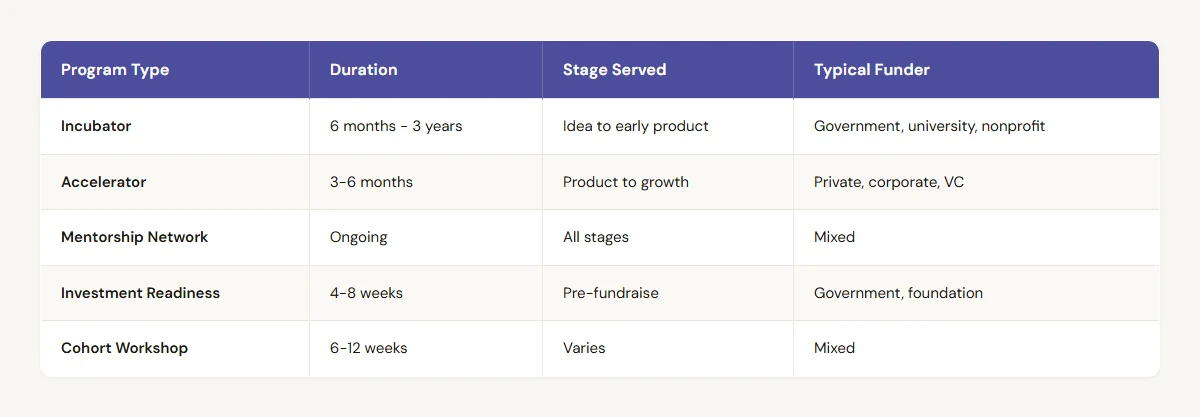
A startup program is a structured offering designed to help founders build, launch, and grow their companies. The term is broad by design. Incubator programs, accelerator programs, mentorship networks, cohort-based workshops, and investment-readiness bootcamps all fall under the category of startup programs.
The organization behind the program is the entrepreneur support organization (ESO). The program is what the ESO delivers. One ESO might run multiple programs: a 12-month incubator, a 3-month accelerator, and a rolling mentorship network. Each is a separate startup program with its own design, audience, and success metrics.
Understanding this distinction matters for ESO leaders because program design is the lever they can pull most directly. The ESO's mission, funding, and team are harder to change. The program's structure, curriculum, and operations can be refined continuously.
The Components of a Startup Program
Every effective startup program includes these components. The quality of each one determines the program's overall impact.
Intake and Selection
How founders enter the program shapes everything that follows. A structured intake process assesses the founder's stage, their current challenges, and their fit for the specific program.
The strongest programs use a diagnostic tool that maps each founder to a lifecycle phase at entry. This allows the program to route founders to stage-appropriate resources from day one rather than treating all participants as a homogeneous group.
Curriculum
Curriculum is the educational content delivered to founders during the program. It can include workshops, online modules, guest speakers, case studies, and hands-on exercises.
The mistake most programs make is running the same curriculum sequence for every cohort regardless of where the founders are. A Phase 1 founder sitting through a workshop on investor term sheets is wasting everyone's time. Stage-mapped curriculum solves this by matching content to founder phase.
Mentorship
Mentorship connects founders with experienced professionals who can guide them through specific challenges. The quality of mentorship depends on matching, tracking, and accountability, not on the size of the mentor roster.
For a complete guide to building this component, see how to build a startup mentorship program.
Community
Peer learning is the most undervalued component of startup programs. Founders in the same cohort share challenges, accountability, and perspective that no mentor or curriculum can replace.
Programs that build community intentionally (through peer working sessions, cohort check-ins, and shared communication channels) report higher engagement and lower dropout rates than programs that leave community to chance.
Capital Access
Some programs provide direct funding (grants, investments). Others connect founders to external funding sources (investor networks, grant databases, lending partners). The form matters less than whether the capital is matched to the founder's stage.
A Phase 1 founder doesn't need an investor introduction. They need a $5,000 prototype grant. A Phase 6 founder doesn't need a grant. They need warm introductions to VCs who invest at their stage and sector.
Outcome Tracking and Reporting
Every program needs a system for tracking founder progress and reporting outcomes to stakeholders. Without it, the program can't demonstrate value, improve its design, or sustain its funding.
Track milestones by phase, not just aggregate revenue or job numbers. Report to sponsors in terms they care about: economic impact for government funders, ROI for corporate sponsors, student outcomes for university leaders.
What Separates Good Programs from Average Ones
Three design decisions separate programs that produce consistent outcomes from those that look active but underperform.
1. Stage-Based Design
Good programs diagnose where each founder is and deliver resources accordingly. Average programs run a fixed sequence of workshops and hope something applies.
Stage-based design requires a framework. The seven-phase Startup Lifecycle gives ESOs a shared vocabulary for diagnosing founder stage and mapping resources to it. Without a framework, stage assessment becomes subjective and inconsistent.
2. Operational Systems
Good programs run on systems that handle applications, cohort management, mentor coordination, curriculum delivery, and reporting in one place. Average programs run on disconnected tools that create manual work, data gaps, and staff burnout. The difference compounds with every cohort.
An ESO management platform is built for exactly this problem. It's the operational infrastructure that lets the program team focus on founders instead of logistics.
3. Continuous Improvement
Good programs use data from each cohort to improve the next one. They analyze which curriculum modules produced the most engagement, which mentors were rated highest, which intake questions predicted founder success, and which milestones correlated with post-program outcomes.
Average programs run the same structure year after year because changing it'd require data they never collected. This is the question most program directors avoid: are you improving, or are you just repeating?
Types of Startup Programs
Frequently Asked Questions
What's a startup program?
A startup program is a structured offering that helps founders build, launch, and grow their companies. It's the activity an ESO delivers. Common formats include incubators, accelerators, mentorship networks, and cohort-based workshops.
What makes a startup program effective?
Stage-based design (matching resources to founder phase), structured mentorship, operational systems that scale, and data-driven improvement between cohorts. Programs that treat all founders the same underperform programs that personalize by stage.
How long do startup programs last?
It depends on the format. According to Wikipedia, business incubators typically support early-stage startups over a period of one to two years, though some programs run as short as a few months or extend beyond three years.1 According to Brookings, startup accelerators are typically fixed-term, cohort-based programs running three to six months.2 Workshop-based programs generally run 6 to 12 weeks, and investment readiness bootcamps typically run 4 to 8 weeks.
Who runs startup programs?
Entrepreneur support organizations: universities, government agencies, nonprofits, corporations, and private entities. One ESO may operate multiple programs simultaneously.
How do I evaluate a startup program before joining?
Look for stage-appropriate curriculum, structured mentorship (not just a mentor list), evidence of outcomes from previous cohorts, and alumni you can talk to. If the program can't tell you its results, that tells you something.
See how Startup Science gives ESOs a single platform for applications, mentorship, and reporting.
Sources
- Wikipedia, Business incubator, 2025. wikipedia.org
- Ian Hathaway, Brookings Institution, Accelerating growth: Startup accelerator programs in the United States, 2022. brookings.edu