The right answer depends entirely on where the founder is in the lifecycle. If they're still in the Vision phase, putting them through a 12-week accelerator is premature. If they're already in Go-to-Market, a slow-burn incubator wastes the window. I've seen both mistakes play out hundreds of times, and the cost is always the same: founders doing the right thing at the wrong time.
Founders researching support programs will eventually run into the same question: startup accelerator vs. incubator, which one is right? Both exist to help early-stage companies grow, but they operate on different timelines, take different equity stakes, and serve founders at different points in the startup lifecycle.
This comparison breaks down the real differences so you can make the decision based on where your company actually is, not where you wish it were.
What Is a Startup Accelerator?
An accelerator is a fixed-term, cohort-based program designed to compress growth into a short window, usually 3 to 6 months. According to Y Combinator, its flagship batch runs as a three-month program.1 Techstars similarly runs a three-month mentorship-driven accelerator,2 and the 500 Global Flagship Accelerator is a four-month in-person program.3 These programs follow a structured curriculum that ends with a demo day where founders pitch to investors.
Key characteristics of accelerators:
- Fixed duration (typically 12 to 24 weeks)
- Cohort model with a class of 10 to 30 startups
- Seed investment and equity typical of top programs, for example, according to the Y Combinator Standard Deal, YC invests $500,000 for 7% plus an uncapped MFN SAFE,4 and Techstars invests $220,000 for 5% in common stock plus an uncapped MFN SAFE2
- Intensive mentorship and curriculum
- Demo day with investor audience
- Highly competitive applications. Y Combinator's Winter 2024 batch accepted roughly 260 companies out of more than 27,000 applicants, an acceptance rate under 1%, per TechCrunch reporting on the batch5
If you don't have a concept and a team, most accelerators won't accept you. The program helps you move faster, not figure out what to build.
What Is a Startup Incubator?
An incubator is an open-ended support environment designed to help founders develop ideas into viable businesses. There's no fixed graduation date. Some founders stay 6 months, others stay 2 years.
Key characteristics of incubators:
- Open-ended timeline (months to years)
- Shared workspace and resources
- May or may not take equity (university incubators often take none)
- Less structured than accelerators
- Focus on idea development, business model validation, and early team building
- Lower barrier to entry than accelerators
Incubators work best for founders still shaping their concept, testing assumptions, or building their first team. University-affiliated incubators are especially common for student and faculty founders.
Side-by-Side Comparison
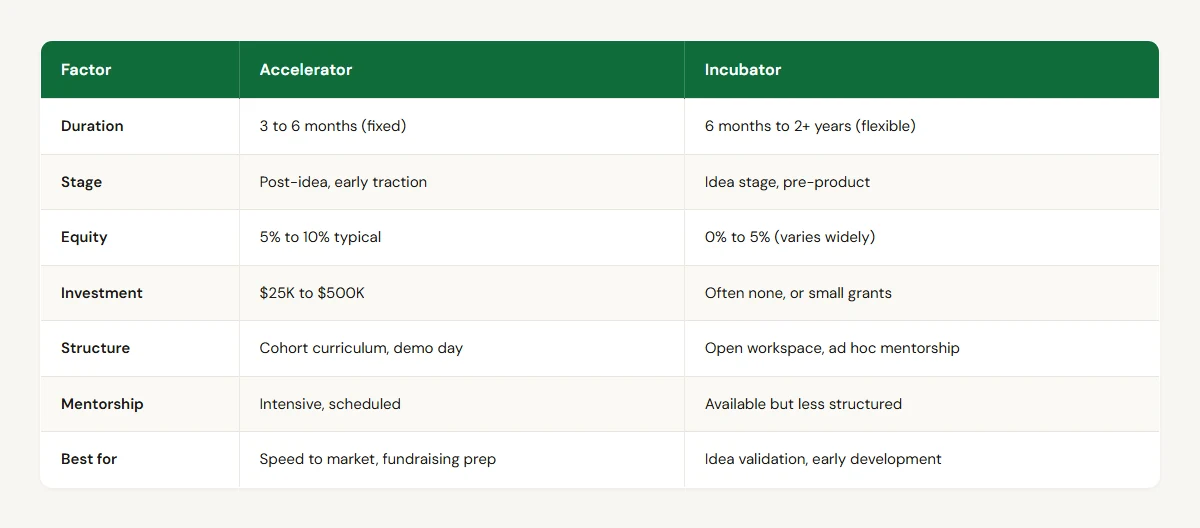
How to Choose Based on Your Stage
The decision comes down to one question: do you need speed or do you need space?
Choose an accelerator if you have a defined product concept, a founding team, and the ability to commit full-time for 3 to 6 months. Accelerators are built for speed. They assume you know what you're building and need help building it faster, raising capital, and connecting with investors.
Choose an incubator if you're still validating the problem or the solution. Incubators make sense when you need affordable workspace and community more than capital, when you want flexibility in timeline, or when you're a student, academic, or first-time founder still shaping an idea.
These programs aren't mutually exclusive, and many founders go through an incubator first before applying to an accelerator once their product and team are further along.
Top Programs to Research
We maintain a curated list of the best startup accelerators with details on equity terms, focus areas, and application windows. That guide is a good next step if you have decided the accelerator path fits.
For founders who want mentorship without the formal program structure, finding an individual startup mentor is another option worth considering.
Where Startup Science Fits In
Startup Science connects founders with accelerators, incubators, and individual mentors through the Founders platform. The platform matches programs to your current lifecycle phase, so you spend time applying to the right programs rather than guessing which ones fit.
The platform also provides curriculum, capital access tools, and advisor matching that complement any program you join. Think of it as the infrastructure layer underneath whatever support program you choose.
Capital strategy and program selection work best when planned together. The funding options guide covers the full picture from grants to venture capital.
Frequently Asked Questions
Is an accelerator or incubator better for a first-time founder?
It depends on how far along you're. If you have an idea but no product, an incubator gives you space to develop. If you have a product concept and a team ready to move fast, an accelerator compresses the learning curve.
Do accelerators always take equity?
Most do. Equity terms vary by program, for example, according to Y Combinator, YC takes 7% for $125,000 (plus an uncapped MFN SAFE for an additional $375,000),4 Techstars takes 5% in common stock for $20,000 (plus a $200,000 uncapped MFN SAFE),2 and 500 Global takes 6% for $150,000.3 Some newer accelerators offer non-dilutive options, and many government-funded programs take no equity at all.
Can I join an accelerator without a technical co-founder?
Yes, though it's harder to get accepted. Some programs pair non-technical founders with developers. Others expect you to have a working prototype before applying.
How competitive are accelerator applications?
Top-tier programs like Y Combinator are extremely selective. According to TechCrunch, YC's Winter 2024 batch drew more than 27,000 applications and accepted roughly 260 companies, an acceptance rate under 1%.5 Regional and industry-specific accelerators typically have higher acceptance rates.
What happens after an accelerator program ends?
Most programs end with a demo day where you pitch to investors. After that, you're on your own operationally, though alumni networks and mentor relationships often continue long after the program.
See how Startup Science helps founders navigate every stage from idea to exit.
Sources
- Y Combinator, What Happens at YC, 2024. ycombinator.com
- Techstars, Techstars Investment Terms Update, 2025. techstars.com
- 500 Global, Flagship Accelerator, 2024. 500.co
- Y Combinator, The Y Combinator Standard Deal, 2024. ycombinator.com
- TechCrunch, In 2024, many Y Combinator startups only want tiny seed rounds, 2024. techcrunch.com