
If you search for "free business mentor," SCORE is probably the first result, and that's for good reason. According to SCORE, the organization has been connecting entrepreneurs with volunteer mentors since 1964 and has helped more than 17 million entrepreneurs start, grow, or exit a business.1 It's free, it's nationwide, and it has helped millions of small business owners.
But most founders never stop to ask whether SBA mentors are the right fit for a startup, and the answer depends on what kind of business you're building. SCORE serves a broad population of entrepreneurs, from main street retail to home services to early-stage tech. That breadth makes it strong for general business guidance but limited for founders navigating the specific challenges of building a high-growth startup.
What SCORE Does Well
SCORE mentors are experienced. According to SCORE, more than 10,000 volunteer expert business mentors provide free mentoring, resources, and education across all 50 U.S. states and territories.2 Mentors typically include former business owners, industry professionals, and executives (both working and retired) who contribute their time through local chapters.
SCORE excels at business fundamentals: financial planning, bookkeeping, business plan development, and local market entry like permits, zoning, and brick-and-mortar operations. It helps first-time entrepreneurs evaluate whether their idea is viable, covers a broad range of industries, and requires zero financial commitment to start.
For a founder launching a local service business or a first-time entrepreneur who needs help with the basics, SCORE is a strong starting point. It's one of several free business mentorship programs that provide legitimate value at no cost.
Where SCORE Falls Short for Startups
Startups face problems that most small businesses never encounter. Venture fundraising, product-market fit, technical architecture decisions, growth-stage hiring, cap table management, and go-to-market timing aren't part of the standard SCORE playbook.
No Stage-Aware Framework
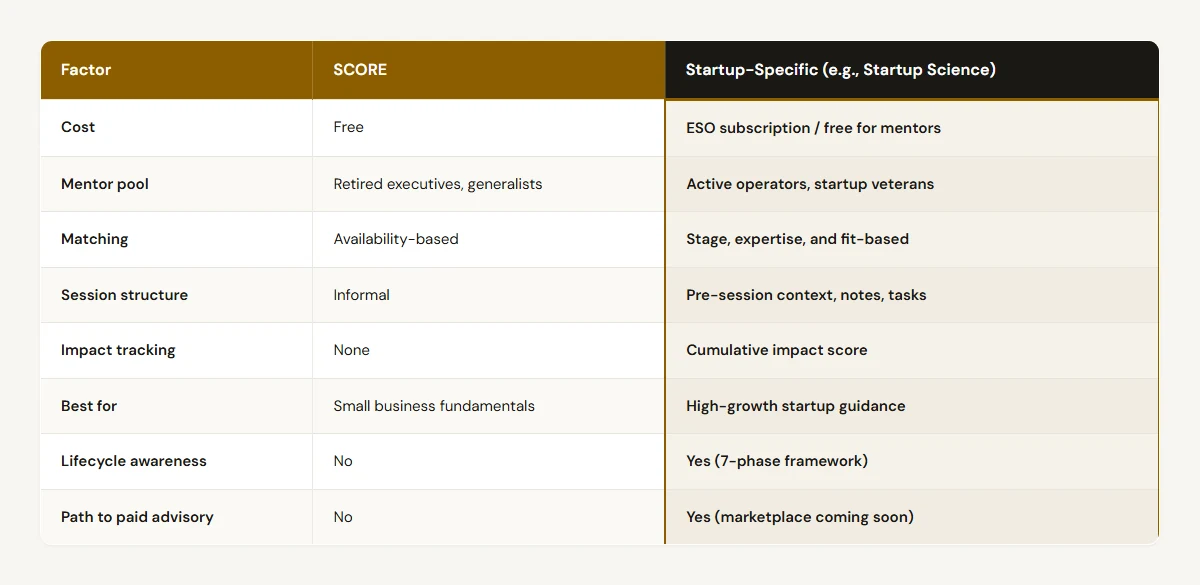
Startups progress through distinct phases, and the challenges of validating a product hypothesis (Phase 2) are fundamentally different from standardizing operations for scale (Phase 4). Startup-specific mentorship platforms like Startup Science match mentors to founders based on their current stage in the seven-phase Startup Lifecycle. SCORE doesn't operate with this kind of lifecycle awareness.
Limited Technology and Venture Expertise
If you're building a SaaS product, raising a seed round, or deciding between technical co-founder equity structures, you need a mentor who has done exactly that. SCORE's volunteer pool skews toward traditional business experience, which means finding a mentor with startup-specific technical or fundraising expertise through SCORE is possible but unlikely.
No Structured Impact Tracking
SCORE sessions are informal, with no pre-session context, no task assignment workflow, and no cumulative impact tracking. For founders who need accountability and measurable progress, this matters. For mentors who want to build a professional advisory practice, the lack of tracking means there's no data trail of your contributions.
Generalist Matching
SCORE matches are based primarily on availability and general topic area. Startup-specific platforms match on multiple dimensions: lifecycle stage, domain expertise, availability, and working style.
When to Use SCORE vs. a Startup-Specific Platform
This doesn't have to be an either-or decision. Many founders benefit from both.
Use SCORE when you're pre-idea or pre-revenue and need help evaluating basic feasibility, your business is a local or small business rather than a high-growth startup, you need help with business fundamentals, or you want a zero-cost starting point before committing to a more structured program.
Use a startup-specific platform when you're building a product or technology company with growth ambitions, you need guidance on fundraising, product-market fit, or go-to-market strategy, you want stage-matched mentorship aligned to your current lifecycle phase, you need accountability through session structure, task tracking, and impact measurement, or you're an ESO looking to build a structured mentorship program for your cohort.
The Mentor Perspective
If you're considering becoming a startup mentor, the same comparison applies from the other side.
SCORE is a good starting point if you want to test whether mentoring fits your schedule and interests without any commitment.
A startup-specific platform is better if you want to mentor high-growth founders, build a measurable track record, and eventually transition into a paid advisory role with a formal agreement. Platforms like Startup Science give mentors pre-session context, structured workflows, and an impact score that compounds over time.
Side-by-Side Comparison
Making the Right Choice
Founders need to understand which mentorship option fits their stage and their needs, because the wrong match wastes everyone's time.
If you're just starting out and need to figure out the basics, SCORE is a great free resource. But if you're building something that needs lifecycle-aware, structured mentorship connected to real progress tracking and stage-matched expertise, you'll outgrow generalist programs quickly.
The best path is often sequential: start with free programs, then move into structured platforms as your company grows and your mentorship needs become more specific. For a broader look at available options, see the mentorship platform comparison guide.
When generalist advice stops being enough, the Startup Science mentor platform connects you with mentors who have built the kind of company you're building, matched to the exact phase you're in right now.
Frequently Asked Questions
Is SCORE mentoring good for startups?
SCORE is effective for early-stage feasibility checks and business fundamentals but isn't optimized for high-growth startups. SCORE mentors tend to have generalist business experience rather than startup-specific expertise in areas like venture fundraising, product-market fit, and technical architecture.
What's the difference between SCORE mentors and startup mentors?
SCORE mentors are volunteer business experts (often former executives, business owners, and industry professionals) who help entrepreneurs with business fundamentals. Startup-specific mentors are usually active operators or exited founders who advise on fundraising, product development, growth strategy, and scaling. Startup platforms also offer structured matching, session workflows, and impact tracking.
Is SCORE free?
Yes. According to SCORE, SCORE is a 501(c)(3) nonprofit and a resource partner of the U.S. Small Business Administration, and it provides mentorship at no cost to entrepreneurs through chapters in all 50 U.S. states and territories.3
Can I use SCORE and a startup platform at the same time?
Yes, and many founders do. SCORE works well for general business fundamentals while a startup-specific platform handles stage-matched growth guidance. The two serve different purposes and complement each other.
How do SBA mentors compare to paid startup advisors?
SBA mentors through SCORE are volunteers who provide free guidance on business basics. Paid startup advisors have formal agreements with defined scope, time commitments, and compensation (usually equity). Paid advisors typically offer deeper, more consistent engagement selected specifically for the founder's current stage.