Mentorship platforms have multiplied over the past five years. Some connect individual mentors with founders one-on-one. Others serve as infrastructure for accelerators and incubators running formal programs. A few try to do both. Most do none of it well.
If you're evaluating mentorship platforms for an ecosystem program or for your own advisory practice, the differences matter. The platform you choose shapes how mentors get matched, how sessions are tracked, and whether anyone can prove the mentorship actually worked.
What to Evaluate in a Mentorship Platform
Before comparing specific platforms, define your criteria.
For individual mentors, the priorities are matching quality, session tools, and impact tracking. You want a platform that connects you with founders who match your expertise and gives you the tools to track your contributions over time. For founders, the priorities are mentor quality, cost, and flexibility: access to experienced advisors who have solved the specific problem you're facing. For ESOs (accelerators, incubators, universities), the priorities are scalability, data, and integration with your broader program. You need a platform that plugs into your cohort management workflow and produces outcome data for stakeholders.
These aren't the same set of requirements. A platform built for one audience will disappoint another.
Platform Comparison
Startup Science
Best for: ESOs running structured mentorship programs; mentors who want measurable impact
Startup Science is ecosystem infrastructure that includes mentorship as a core module within a larger platform for managing startup programs. Mentors build profiles, get matched with founders based on expertise and lifecycle stage, review pre-session context cards, and capture notes and tasks post-session. Everything connects to the founder's progression through the seven-phase Startup Lifecycle.
The standout feature is the impact tracking system. Mentors get a cumulative impact score based on sessions conducted, tasks completed, and founder milestones reached. For ESOs, mentorship data feeds directly into program-level reporting.
An advisor marketplace is in development, which will allow mentors to transition from volunteer mentorship to paid advisory services.
Strengths: Lifecycle-aware matching, pre-session context, impact measurement, ESO integration Considerations: Best suited for programs that use the full Startup Science platform
MentorCruise
Best for: Individual founders looking for 1:1 paid mentorship
According to MentorCruise's homepage, the platform is a marketplace connecting founders and professionals with 6,900+ vetted mentors across 130+ countries.1 Mentors set their own rates on their profiles, with monthly plans typically ranging from roughly $50 to $400+ depending on experience, plus optional one-off sessions starting around $39.2 Sessions happen over 1-on-1 calls with personal chat messaging between sessions.1
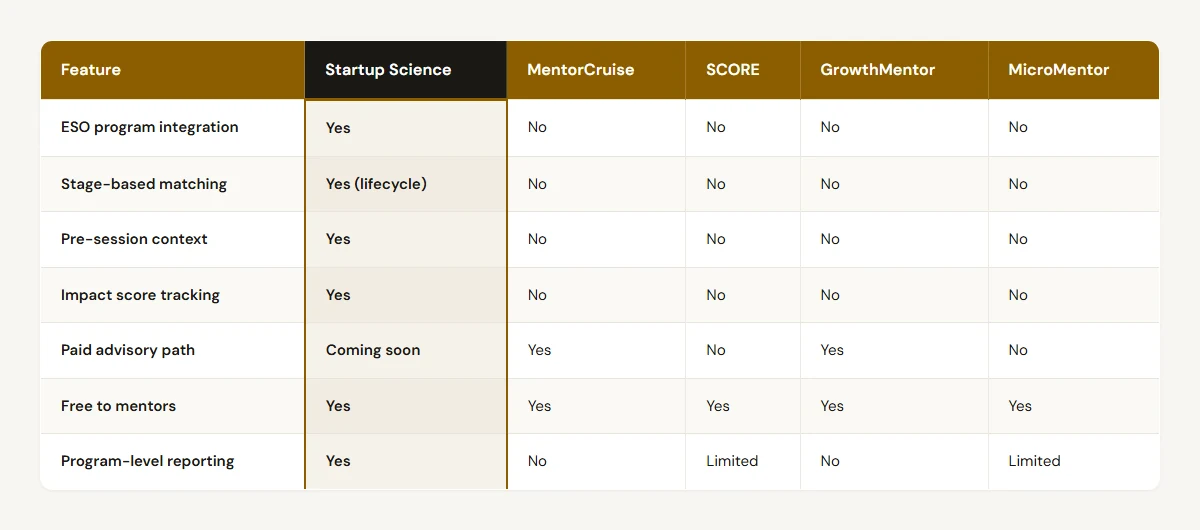
Strengths: Large mentor pool, flexible pricing, easy to start Considerations: No ESO integration, limited program-level analytics, no lifecycle framework or stage-based matching
SCORE
Best for: Early-stage founders and small business owners looking for free mentorship
According to SCORE's About page, SCORE is a 501(c)(3) nonprofit and resource partner of the U.S. Small Business Administration that connects entrepreneurs with approximately 10,000 volunteer business mentors across all 50 states and U.S. territories.3 Mentoring is described as "a free, confidential service for anyone starting, running, or growing a U.S.-based small business."4
For a detailed comparison of SCORE mentorship versus startup-specific platforms, see the SBA SCORE vs. startup mentors guide.
SCORE publishes aggregate program impact data; for FY24 it reported 59,447 new businesses launched and 143,623 new jobs created5, but tooling for per-mentor or per-cohort tracking inside a specific accelerator workflow is limited based on public materials.
Strengths: Free, nationwide coverage, established reputation Considerations: Generalist small-business mentors (not startup-specific), limited self-serve technology platform, no cohort-level impact tracking for third-party programs
GrowthMentor
Best for: Growth-stage founders looking for on-demand advice
According to GrowthMentor's pricing page, GrowthMentor operates as a flat-rate subscription platform where solo plans start at $50/month on an annual commitment and go up to $150/month for a single month, where members get unlimited 1:1 sessions with 700+ vetted mentors.6 The mentor pool is heavily curated; the company states it rejects roughly 95% of mentor applicants.7 Focus areas concentrate on growth strategy, scaling, sales, go-to-market, and fundraising.7 GrowthMentor reports that over 80% of mentors offer sessions for free, with new mentors expected to complete at least three reviews before charging.8
Strengths: Curated mentor quality, session-based flexibility, focused on growth topics Considerations: Not built for ESO programs, subscription model may not fit all budgets
MicroMentor
Best for: Social-impact-focused mentorship, emerging market entrepreneurs
According to MicroMentor's homepage, MicroMentor connects entrepreneurs with experienced volunteer mentors globally and is "free forever, for everyone."9 The platform reports that 66% of the entrepreneurs it serves have no access to other business development resources.9
Strengths: Social impact focus, free, global reach Considerations: Volunteer-only (no paid advisory path), limited structured tools
Feature Comparison Table
Choosing the Right Platform
If you're an ESO managing cohorts and need mentorship woven into your program management workflow, Startup Science is the only platform in this set designed specifically for that use case.
If you're an individual founder looking for a paid mentor on a specific topic, MentorCruise offers the deepest marketplace of mentors who set their own rates,2 while GrowthMentor provides a flat-rate subscription with unlimited sessions (though most GrowthMentor sessions are volunteer rather than paid advisory).8
If you're a first-time founder with no budget, free mentorship programs through SCORE, MicroMentor, or local SBDCs are a solid starting point.
If you're a mentor looking to build a professional advisory practice with measurable results, focus on platforms that offer impact tracking and a path from volunteer mentorship to paid advisory. Without data proving your impact, mentorship stays a hobby.
For mentors just getting started, the guide to becoming a startup mentor covers the full path from first session to established advisory role.
The right platform depends on what you need it to do. If you want mentorship woven into a full program management system, start with Startup Science and see what structured looks like.
Frequently Asked Questions
What's the best mentorship platform for startups?
The best platform depends on your role. For ESOs running structured programs, Startup Science integrates mentorship with full cohort management. For individual founders seeking paid 1:1 mentorship, MentorCruise and GrowthMentor offer flexible options. For free mentorship, SCORE and MicroMentor provide volunteer mentor access.
Are there free mentorship platforms for entrepreneurs?
Yes. SCORE provides free mentorship through volunteer mentors nationwide in the United States. MicroMentor connects entrepreneurs with volunteer mentors globally. Many local Small Business Development Centers also offer free mentoring services.
What features should a mentorship platform have for accelerators?
Accelerators should look for stage-based matching, pre-session context delivery, session documentation tools, impact tracking, program-level reporting, and integration with cohort management workflows. These features ensure mentorship produces measurable outcomes that can be reported to stakeholders.
Can mentors get paid on mentorship platforms?
Some platforms support paid mentorship. MentorCruise lets mentors set their own monthly plans and per-session rates.2 GrowthMentor allows mentors to charge after accumulating three reviews, though the platform reports that over 80% of its mentors offer sessions for free.8 Startup Science is developing an advisor marketplace that will allow mentors to offer paid advisory services. SCORE and MicroMentor are volunteer-only.49
How do mentorship platforms match mentors with founders?
Methods vary. Basic platforms let founders browse profiles. Advanced platforms use algorithms that consider stage alignment, domain expertise, availability, and working style. Startup Science matches based on the founder's current lifecycle phase, which ensures the mentor's experience maps to the founder's specific challenges.
Sources
- MentorCruise, Homepage: Find a Mentor, accessed 2026. mentorcruise.com
- MentorCruise Help Center, How do payments work? How much does it cost?, accessed 2026. help.mentorcruise.com
- SCORE Association, About SCORE, accessed 2026. score.org
- SCORE Association, Homepage: Free Small Business Mentoring, accessed 2026. score.org
- SCORE Association, FY24 Annual Impact Shows, accessed 2026. score.org
- GrowthMentor, Membership Pricing, accessed 2026. growthmentor.com
- GrowthMentor, Homepage: Startup Mentorship Platform, accessed 2026. growthmentor.com
- GrowthMentor, 5 Reasons Mentors Do It for Free, accessed 2026. growthmentor.com
- MicroMentor, Homepage: Free Business Mentorship, accessed 2026. micromentor.org