Guy Kawasaki likes to say that great companies do one of three things: increase quality of life, right a wrong, or prevent the end of something good.
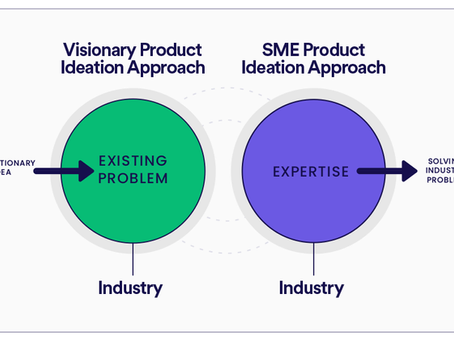
But you still need to start with an idea. And in our experience, founders who generate successful product ideas typically fall into one of two categories: visionaries or subject matter experts.
The Visionary Approach
Visionaries tend to be industry outsiders who bring a new way of thinking to existing problems. They start with a solution (the hammer) and look for problems it can solve (the nails), even across industries they've never worked in.
The visionary's advantage is fresh perspective. They aren't constrained by "the way things have always been done." Their disadvantage is that they may underestimate the complexity of the industry they're entering.
The Subject Matter Expert Approach
Subject matter experts (SMEs) are already immersed in an industry. They spot problems through direct experience and build solutions informed by deep domain knowledge.
Here's an example. Brian worked for 20 years as an engineer at a water treatment facility. During that time, he improved the systems at his own plant. At a regional engineering conference, he heard other facilities complain about the same inefficiencies his innovations had already solved. He mapped the industry ecosystem, researched how competitors addressed the problem, and realized his solution was more efficient, increased capacity, and delivered significant cost savings.
Brian had a product idea born from expertise. His knowledge of the industry meant he could validate the opportunity faster than an outsider.
When Visionaries and SMEs Combine
The strongest startups often combine both perspectives. In Brian's case, his friend Estela saw potential for his water treatment innovation in industries he had never considered, like agriculture and manufacturing. She was the visionary who saw the broader market. He was the SME who understood the technology deeply enough to adapt it.
This is a pattern we see repeatedly. The Vision phase of the Startup Lifecycle is where this ideation happens, where founders define what they're building and why it matters. Whether you start as a visionary or an SME, the process of validating the idea, mapping the ecosystem, and testing assumptions follows the same structured path.
From Idea to Validation
Having a good idea is necessary but not sufficient. The next step is validation: confirming that real customers will pay for your solution and that the market is large enough to build a business around it.
The Startup Lifecycle framework maps this journey from ideation through product development and into go-to-market. Each phase has specific milestones that help founders (whether visionary or SME) make better decisions with less wasted time and capital.
Explore the Startup Lifecycle or read The Startup Lifecycle for the full framework.