If you just want the rounds side by side, start with the table below. Most founders don't need a 2,000-word essay on each stage; they need to see, at a glance, how much each round raises, who leads it, what it expects, and what it costs in equity. This page is the scannable version. When you want the deep mechanics of one specific raise, our guide to how to raise a Series A goes round by round, and the full funding rounds explainer walks the whole progression in narrative form.
The numbers below reflect 2025-2026 data from Carta and our own research across 2,200 founders who walked these stages, mapped to the startup lifecycle stages we use at Startup Science.
Every Round at a Glance
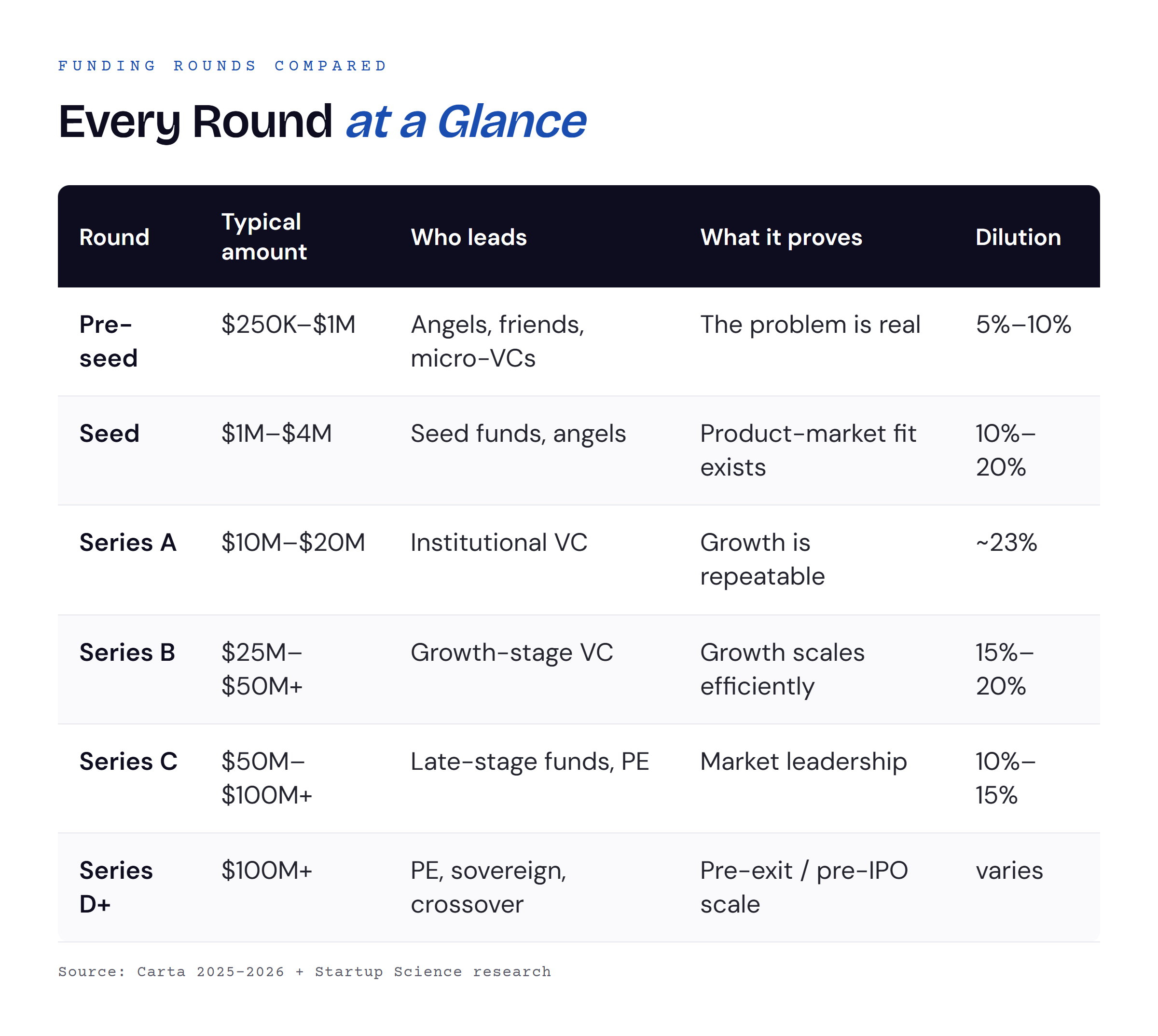
Read the table top to bottom and the pattern is clear: each round raises more, dilutes a little less as valuations climb, and demands harder evidence than the one before. The capital follows the proof, never the other way around.
Seed Funding vs Series A
This is the comparison founders get wrong most often, and it's the cheapest mistake to avoid. Seed proves something can work; Series A proves it works repeatably.
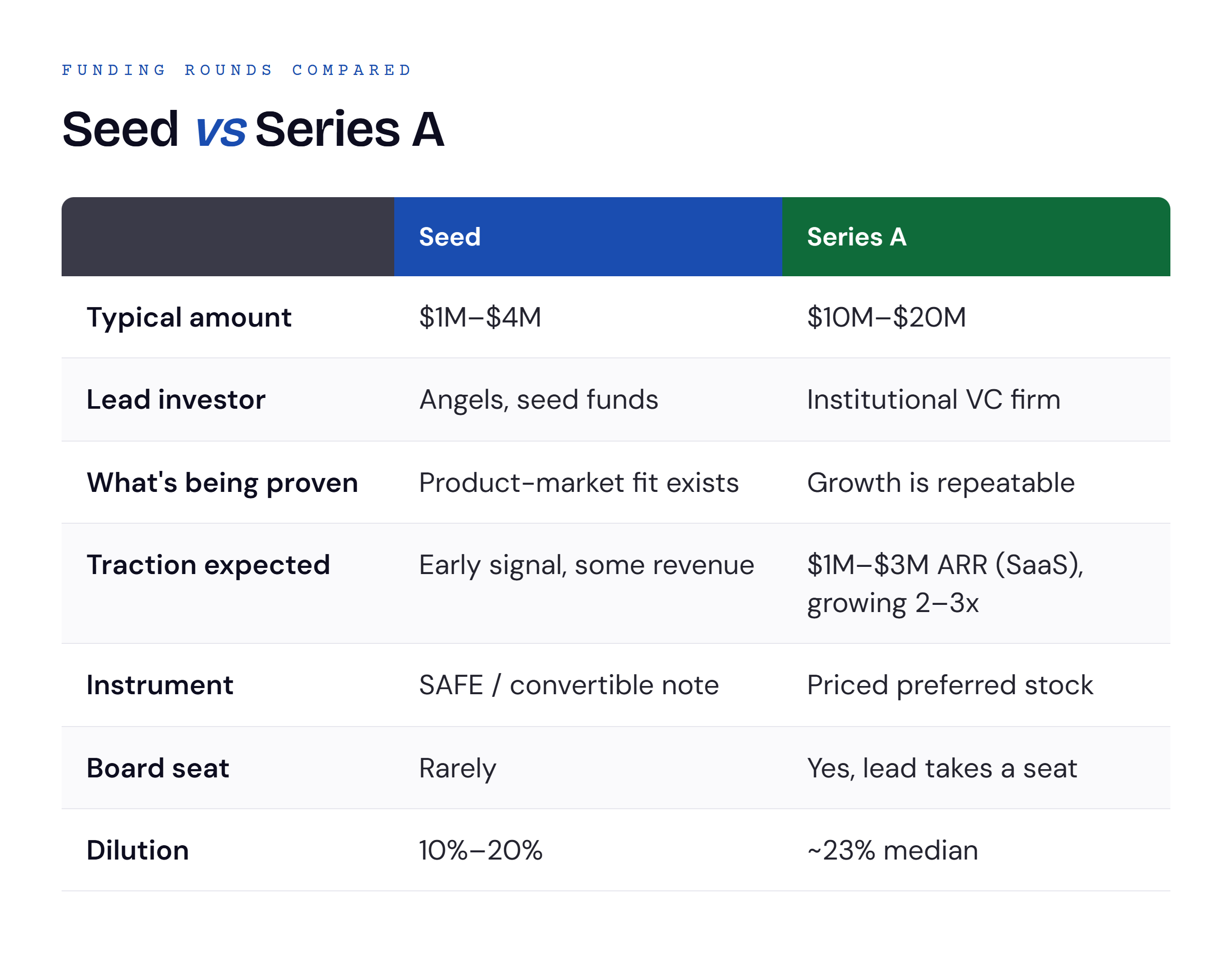
The takeaway: a seed round buys runway to find product-market fit; a Series A funds the engine you build once you've found it. If you're still searching for fit, raising an A early just lets you search more expensively.
Series A vs Series B
By Series B the model already works. The question shifts from "can this grow?" to "does each dollar of growth pay off?"
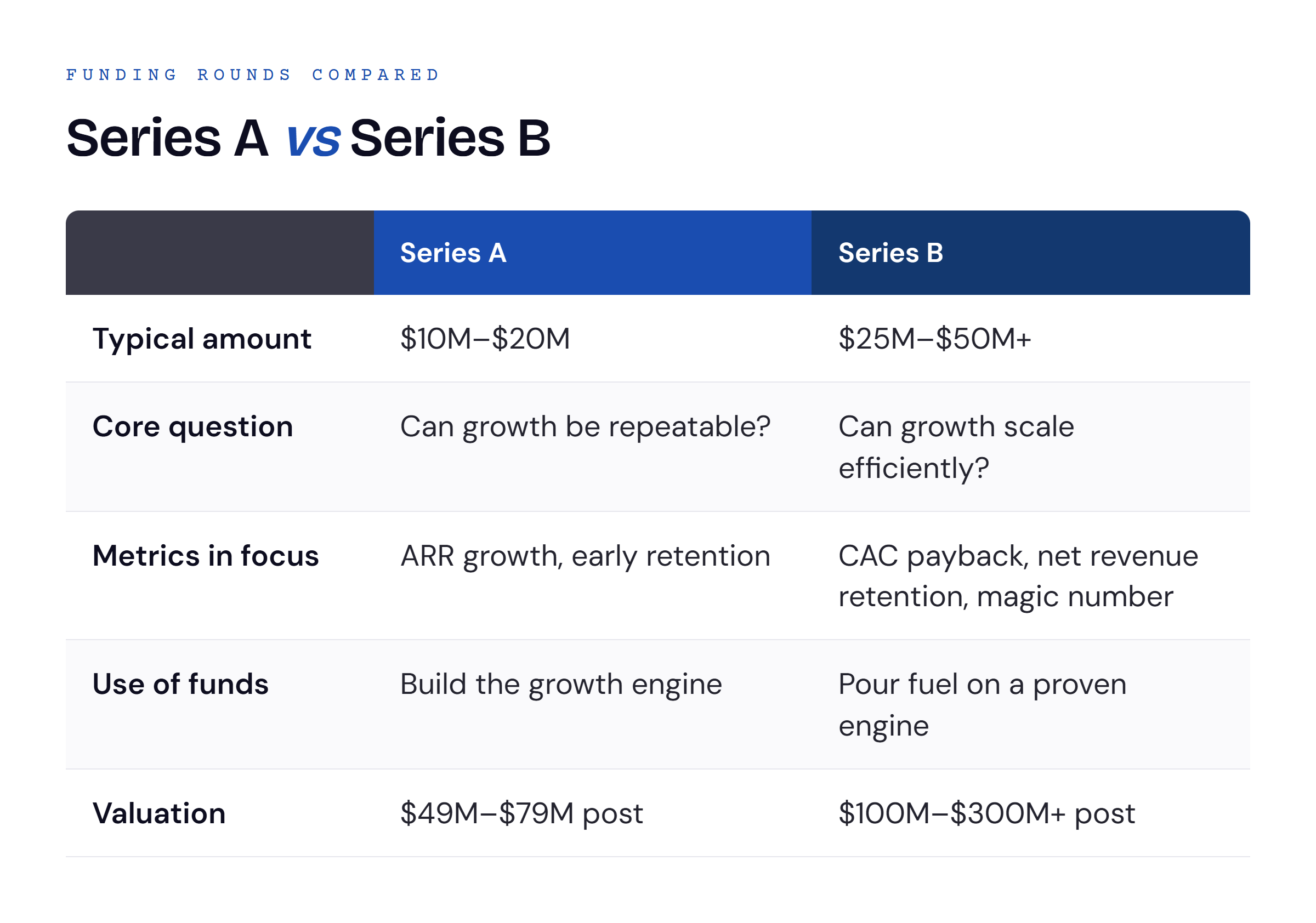
The takeaway: Series A investors fund potential backed by early proof. Series B funding investors fund a proven model and expect the unit economics to hold as you spend more. "We're growing fast" stops being enough at B.
Series A and B Funding: Why Founders Plan Them as a Pair
Search "series a and b funding" and you'll find most results treat them separately. In practice, the best founders plan them together, because the milestones you commit to at Series A are exactly what make Series B raisable.
Here's the logic: your Series A pitch promises a specific outcome ("$15M takes us to $8M ARR in 18 months"). That promise becomes your Series B entry ticket. Miss it and the B round gets hard no matter how good the story is; hit it and the B often comes to you. So when you raise an A, you're really setting the terms of the B. Treat the two as one 30-month arc with a checkpoint in the middle, not two disconnected events.
This is also where the capital tools founders use to model dilution across both rounds earn their keep: the equity math at A determines how much room is left at B, and you want to see that on one cap table before you sign the first term sheet.
Series B, C, and D at a Glance
The later rounds get less coverage because fewer companies reach them, but the standalone questions are common. Quick reference:
Series B funding. The scaling round. $25M to $50M-plus to take a working model and expand it: more markets, more product lines, a real go-to-market machine. Investors underwrite efficiency metrics, not just growth.
Series C funding. The market-leadership round. $50M to $100M-plus, often from late-stage funds and private equity. The company is established; the capital funds dominance, acquisitions, or international expansion. Financials get scrutinized like a public company's.
Series D funding. Usually one of two stories: a pre-IPO push, or a "we need more time" round when the IPO or acquisition window hasn't opened yet. $100M-plus, with the tightest diligence of any private round. Not a milestone every company wants to need.
Not every startup raises all of these. Many reach profitability or exit before Series C, and that's a healthy outcome, not a shortfall.
Which Comparison Matters for You
Find your situation, then read the right deep-dive:
- Deciding between seed and an A? The seed-vs-A table above plus the seed funding guide covers it.
- Raising a Series A right now? Skip the comparisons and go to how to raise a Series A.
- Want the full narrative of every stage? The funding rounds explainer walks pre-seed through C+ in prose.
- Running a cohort of founders at different stages? ESOs use Startup Science to track founder funding progress across a whole portfolio, so you know who's seed-ready versus A-ready at a glance.
Frequently Asked Questions
What does "series A and B funding" mean?
It refers to a company's first two institutional rounds together. Series A funds building a repeatable growth model; Series B scales that model once it works. Founders often plan them as a pair because the targets set at A are what make B raisable.
What is the difference between seed funding and Series A?
Seed proves product-market fit exists; Series A proves growth is repeatable. Seed is smaller ($1M to $4M), usually on SAFEs from angels and seed funds. Series A is a larger priced round ($10M to $20M) led by an institutional VC who takes a board seat.
How is Series B different from Series A?
Series A funds building a growth engine; Series B fuels one that already works. At B, investors weigh efficiency (CAC payback, net revenue retention) over raw growth, and round sizes roughly double from $10M to $20M to $25M to $50M-plus.
How much equity do you give up across all the rounds?
Roughly: 5% to 10% at pre-seed, 10% to 20% at seed, ~23% at Series A in 2026 (Carta), and 15% to 20% at Series B, with later rounds diluting less as valuations rise. Founders model dilution across all rounds before raising the first, because each round resets the cap table.
What comes after Series C funding?
Series D and beyond, which fund pre-IPO scale, acquisitions, or extra runway when an exit window hasn't opened. Each later round demands tighter financials, and many companies exit or reach profitability before they ever need one.