The best deal I ever closed started with a warm introduction from an accelerator director who'd been using our evaluation framework with her cohort. She'd already vetted the company against the lifecycle before she picked up the phone. That's what good deal flow infrastructure looks like: the filtering happens before the opportunity reaches your inbox.
Most investors manage deal flow in a spreadsheet, a CRM repurposed from sales, or a combination of inbox folders and memory. It works until it doesn't. Deal flow management software exists to solve a specific problem: organizing, evaluating, and acting on investment opportunities at a pace and volume that manual systems can't sustain, but the category is crowded, and most tools solve the wrong part of the problem.
This guide breaks down what deal flow management software should actually do, where the current tools fall short, and what features matter most for investors who want higher-signal pipelines in 2026.
Why Generic CRMs Fail at Deal Flow
Salesforce, HubSpot, and Pipedrive were built to track sales prospects through a buying cycle. Investors adopted them because nothing better existed. The problem is structural: CRMs assume the user controls the data entry. Every field is only as accurate as whatever the investor (or an associate) typed in.
For deal flow, this creates three specific failures:
First, data quality depends entirely on manual entry. Founders send decks in different formats with different metrics, and someone on the team has to normalize everything before a single comparison is possible. At 50 deals a month, that's a full-time job. At the volume seen by top firms, it becomes impossible. According to Venture Capital Careers, smaller firms see around 30 deals per week, while larger firms receive 200 or more in the same window.1
Second, stage tracking is self-reported. When a founder says they're "Series A ready," there's no verification layer. CRMs store whatever the user enters. They have no way to tell you whether the startup has product-market fit or is still iterating on an MVP.
Third, portfolio visibility disappears after the check clears. CRMs track the pipeline to close. After investment, most firms rely on quarterly founder updates sent via email. If a portfolio company misses a milestone or burns through runway faster than projected, the CRM won't flag it.
These aren't feature gaps. They're architectural limitations. The tool was designed for a different job entirely.
What Deal Flow Software Should Actually Do
Purpose-built deal flow software solves the problems that CRMs can't because it starts from a different data model. Instead of treating startups as contacts to be logged, it treats them as entities to be tracked over time against a structured framework.
Here's what the feature checklist should include:
Structured startup profiles. Every startup should present the same data points in the same format. No more normalizing pitch decks manually. The profile should include stage, sector, geography, traction metrics, and team composition in a standardized view.
Verified activity data. The best deal flow tools don't rely on founder self-reporting. They track actual progress: milestones completed, programs participated in, advisor engagement, and product development activity. This is the difference between a CRM field that says "Phase 3" and a system that confirms it based on verified behavior.
Lifecycle or stage scoring. A good deal flow platform assigns stage based on what a startup has done, not what the founder claims. Startup Science uses a 7-phase Startup Lifecycle to score startups from Vision through Exit, with each phase determined by verified activity across the platform.
Real-time portfolio tracking. After investment, the software should continue working. Milestone notifications, lifecycle movement, and progress dashboards replace the quarterly email update. This is where portfolio management capabilities become part of the same system.
Warm introduction pathways. Cold inbound is low-signal. The best deal flow comes through trusted networks. Software that connects investors to startups through ESO relationships (accelerators, incubators, university programs) provides introductions that carry context and credibility.
Feature Comparison: CRMs vs. Purpose-Built Deal Flow Platforms
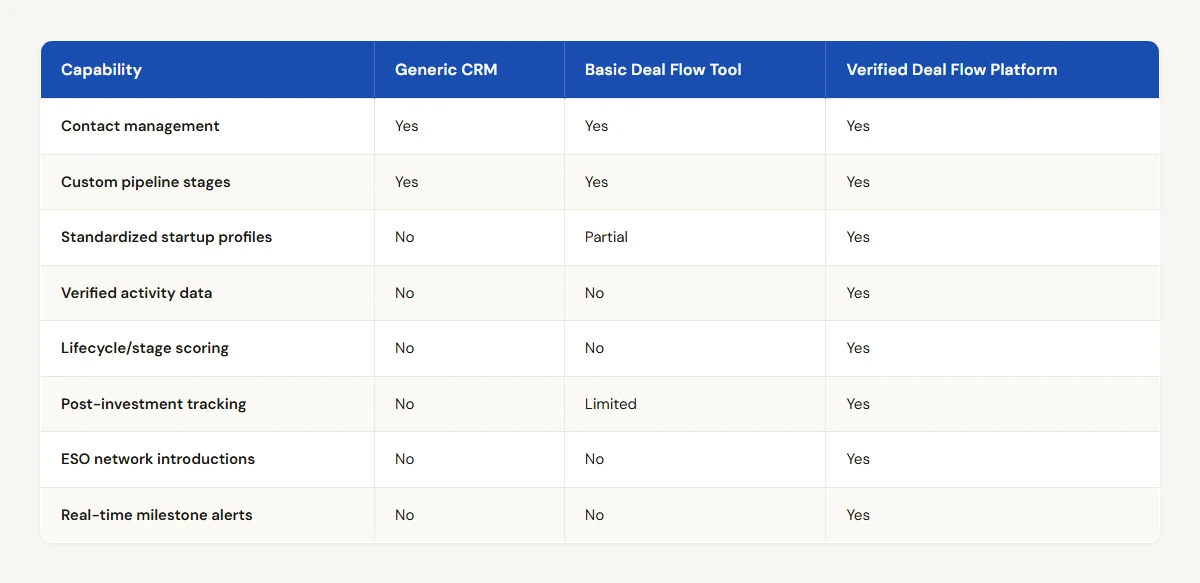
These tools improve on CRMs but still depend on investor-entered data. The right column describes what becomes possible when the data source is the startup ecosystem itself.
How Verified Data Changes Deal Sourcing
The core problem with most deal flow management software is the data input layer. If every data point enters the system through manual entry, the system inherits every bias, error, and gap from that process.
Verified data flips the model. When startups operate within structured programs (accelerators, incubators, university entrepreneurship programs), their activity generates data as a byproduct: curriculum completed, milestones hit, mentorship sessions attended, pitch events participated in. That activity data, aggregated and scored against a consistent framework, is more reliable than any pitch deck.
For investors, this means two things. First, the deal flow entering the system has already been pre-qualified by ESO participation. These aren't random cold submissions. They're startups that have gone through structured programs with real accountability. Second, the evaluation baseline is consistent. Every startup is scored against the same lifecycle framework, so comparing a Phase 3 fintech to a Phase 3 healthtech startup starts from the same standard.
This is what Startup Science's investor tools are built around. The platform aggregates verified startup data from across the ESO ecosystem and presents it in a format that reduces the time between discovery and informed decision.
What to Evaluate Before You Buy
If you're comparing deal flow management software for your firm, run each option against these questions:
Start with the data source. If the answer to "where does the data come from?" is "you enter it," the tool is a database, not a sourcing engine. Look for platforms that pull from structured ecosystems with verified activity.
Then ask how stage is determined. If stage is a dropdown the founder fills in, it's an opinion, not a score. Scoring models tied to actual milestones and activity are the only ones worth trusting.
Check what happens after you invest. If the tool stops being useful after the deal closes, you'll end up running two systems. Portfolio tracking should be built into the same platform.
Ask how the tool connects you to deal flow. Filtering a database is table stakes. The real question is whether the platform creates warm introduction pathways through trusted networks like ESO programs or whether you're still sourcing on your own.
Finally, find out whether you can see what's actually happening at the startup. Dashboards that show last-updated timestamps aren't the same as real-time activity feeds. Look for milestone tracking, lifecycle movement, and progress indicators that update without founder effort.
The Market in 2026
The deal flow software market is still early. Most tools compete on CRM features: better tagging, better search, better email integration. Those features are nice. They don't solve the fundamental data quality problem.
The firms that will have an information advantage in the next cycle are the ones connected to verified startup ecosystems where data is generated by activity, not by pitch decks. That shift from self-reported to verified is the dividing line in this category.
Whether you're a VC evaluating hundreds of deals per quarter, a PE firm focused on later-stage deal flow, or an angel investor looking for pre-qualified opportunities, the question is the same: is the software showing you what founders say, or what founders have actually done?
If you want to see what deal flow management looks like when the data is verified by default, Startup Science is accepting early access requests from investors.
Frequently Asked Questions
What's deal flow management software?
Deal flow management software is a tool that helps investors organize, evaluate, and track investment opportunities. It replaces spreadsheets and repurposed CRMs with purpose-built pipelines, startup profiles, and evaluation workflows designed for the investment process.
How's deal flow software different from a CRM?
CRMs are built for sales teams and depend entirely on manual data entry. Deal flow software is built for investors and can include features like standardized startup profiles, stage scoring, and portfolio tracking that CRMs don't offer natively.
What's verified deal flow?
Verified deal flow means the startup data in the system comes from actual activity (milestones completed, programs participated in, mentorship sessions attended) rather than self-reported claims in a pitch deck. Platforms connected to ESO ecosystems can generate this verified data as a byproduct of program participation.
Can deal flow management software track portfolio companies after investment?
Some can. Basic tools focus only on the pre-investment pipeline. More complete platforms like Startup Science include portfolio dashboards with real-time milestone tracking, lifecycle movement, and progress notifications that replace quarterly email updates.
How much does deal flow management software cost?
Pricing varies widely. General-purpose CRMs like HubSpot offer free tiers and paid plans starting around $90/user/month, while dedicated deal flow tools sit higher. According to Peony's 2026 venture capital software guide, 4Degrees starts at roughly $100/user/month, and Affinity's annual plans run from $2,000 to $2,700 per seat per year (approximately $165-$225/user/month).5 Verified deal flow platforms that include sourcing, scoring, and portfolio tracking are typically priced for institutional investors. Startup Science is currently in early access for investors.
Sources
- Venture Capital Careers, A Guide to Venture Capital Deal Flow, 2024. venturecapitalcareers.com
- Affinity, Venture Capital CRM & Deal Management Software, 2025. affinity.co
- 4Degrees, Deal Flow Management Software, 2025. 4degrees.ai
- Visible.vc, Visible for Investors, 2025. visible.vc
- Peony, Best Venture Capital Software (The $620/mo Stack) in 2026, 2026. peony.ink